Property:Development:41.Temporary/Dwellings
Summary
Notes
- Portable houses to look at for year 1:
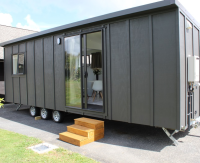 Coastal Cabins 220pw
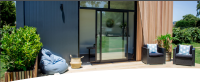 Podlife 15sm 2.7 tonnes ensuite, kitchenette. rent to own.
- 20 ft shipping container Cost $2600 +gst to buy, to rent $3.50 per day+gst,
- transport $210 +gst approx $1500pa
- Lt transport hiab for container 21 meter clearnce $150 ph + gst
- Metal Craft Insulated Panels (ph: 09 277 8844) thermospan: 150 ml spans 6.1 meters 77 sqm +gst 1 meter cover Thermopanel 150 ml 66per sqm +gst 1.2 meter cover (150 is the minimum for accomodation) 15yr warranty (50 yr durability) exterior layer is considered vapour barrier. Does not require bracing except where large cuts (doors windows ) exsist. All codemarked. Refer to technical specs at website to achieve code compliance. can be 2 colours, internal/external. For wind zones up to and including Extra High Zones.(wind pressuer of 2.5KPa ULS)
- Research Kingspan min 284 msq shipped from Aus.
- Call Redco engineers red@redco.co.nz in Tauranga for technical specs.+64 7-571-7070 Deliver just panels. Cut with circular and skill saw. Can use butanol tape for overlaps, less overhang is better. Can order direct with metalcraft.
- “Design around the characteristics of the material”, which is essentially what Nick Grant is saying (and what I believe I did).
- Photos from a SIP build What I did: Walls straight, as few corners as possible, 90° angles - essentially a rectangle. *Single plane mono-pitch roof sized to not need structural supports. One line of spouting. *Decision to use ex-factory panel finish. *Moderate size (about 160m²). Attention to efficient use of space (function over form - architects may hate it). But also some allowance for accessibility. *No ceiling voids except what I've installed in bathrooms and will install in entrance hall - eliminates cost of material for level ceiling. *Use Metrapanel as much as possible to form part of wardrobes, cabinets and closets. An extra metre or so Metrapanel is far less expensive than adding cabinets later. *Glazing as much fixed glass as code allows, no side lights, as few elements as possible - entry doors one piece glazed, one French door with one side tilt and turn (to provide a large opening into the house), all other doors one fixed panel and one tilt and turn door, the one window is a tilt and turn window. Tilt and turn on the doors was more cost effective than a separate opening section. *Bathrooms and kitchen clustered around water cylinder - shorter pipe runs. *No bath (just two showers). *Bathroom taps and fittings are “budget” from Bunnings, Mitre10, salvage places, etc. Select carefully and quality is as good as (sometimes better) than many times the price. *Stainless steel kitchen counter (CNS.co.nz). Tough and good cost. *Easy cable runs for electrician. Mostly surface fixing (covered later). Back-to-back power outlets where possible. No services in external walls or roof. Window dimensions were quite easy - essentially determined by cost. The structural engineer advised that if each wall panel had at least 200mm width going all the way down to the floor, there was no need for structural stiffening over the top of openings. This determined a maximum width of 2m. It’s not that it’s impossible to go wider, but that going wider would have added disproportionally to cost - something I was avoiding wherever possible. The thing to avoid is to have an entire panel being supported by a window/door. We went with 2.2m high doors because higher would have meant a big step up in door cost.There is only one window in the house. All the north facing glazing uses inward opening tilt & turn French doors from And I whole-heartedly recommend them. Our doors look a bit like these ones. All are double sash - four have a single tilt and turn sash and one fixed sash, and the central door has a single tilt and turn sash and a conventionally opening sash, proving a 1.8m wide entry into the house. I regret now not having placed the doors flush with the inner skin, as that would have allowed the central door to open flat against the wall. Oh well. All panels (wall, floor and roof) are 250mm thick. The roof thickness was determined by the clear span needed (about 7m) and the cantilever available (about 3.3m), the floor thickness by the need to be firm underfoot (thinner would be code compliant, but would 'bounce'), wall thickness a combination of factors; a relatively small cost increase for added thickness, availability of colour in that thickness, the expectation of better acoustic performance than thinner panel (a wrong expectation as it turned out) and a perception of better seismic performance. Wellington Urban Plan
- PVC battens:

